
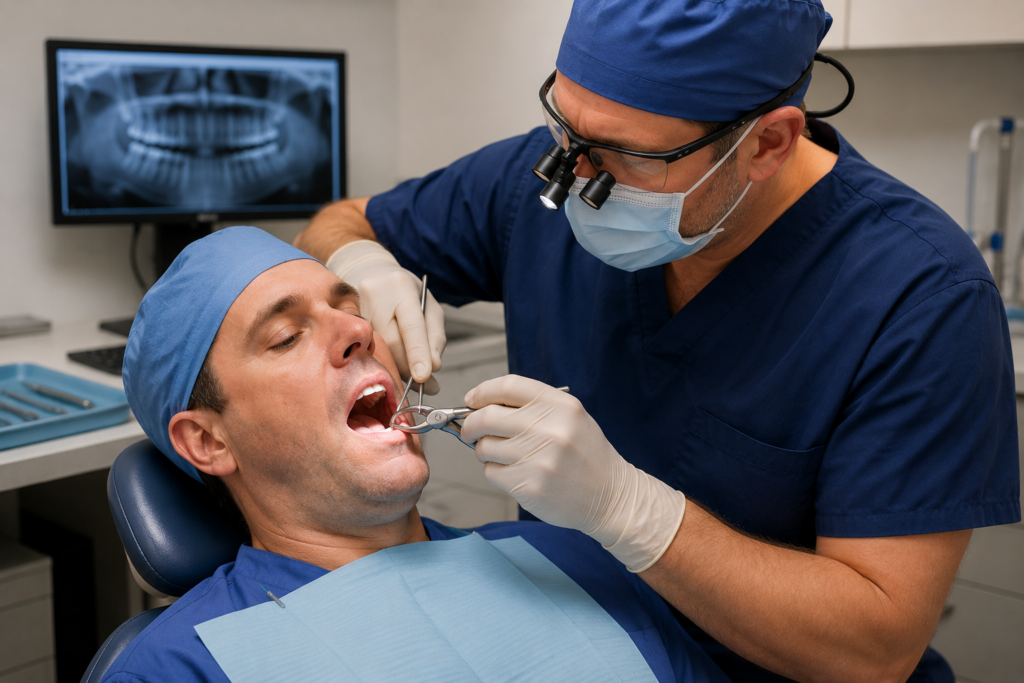
My Recent Experience in the Chair
By Dr. Grant Stucki
Last week, I had my own tooth extracted — tooth #31.
As an oral surgeon, I perform extractions every day. I explain procedures to patients, reassure them, and work hard to make the experience as comfortable as possible. But sitting in the patient chair myself gave me a completely different perspective.
Honestly, it was not fun.
It took several rounds of local anesthetic to get the tooth numb, and even then, I still felt deep pressure and nerve discomfort during parts of the extraction. The very first injection — an inferior alveolar nerve block — sent a sharp electric sensation down my lingual nerve, and the side of my tongue burned intensely for a moment. While the incision and flap reflection were not painful, I became acutely aware of every sound, every vibration, every twist of the tooth, and every additional injection needed to keep me comfortable.
At one point, after receiving a mylohyoid injection because the standard block still was not fully effective, I suddenly felt lightheaded. My vision began narrowing at the edges, and I knew I was close to passing out. We paused treatment, gave me oxygen, and let me recover before continuing.
Even something as simple as rinsing with salt water felt strange and uncomfortable in that moment.
The entire experience left a lasting impression on me — not because anything was done incorrectly, but because I finally experienced firsthand what many patients feel during oral surgery procedures: vulnerability, anxiety, discomfort, uncertainty, and the overwhelming awareness that someone is working inside your mouth while you are awake.
I walked away from that appointment with a much deeper sense of empathy for my patients.
More importantly, I left asking myself an important question:
“How can I make this experience better for the people who trust me with their care?”
What I Want to Do Better for My Patients
This experience reinforced many small details that can make a huge difference in patient comfort.
Preparation Matters
I want to be even more intentional about reviewing each patient’s chart before walking into the room so I can better understand their concerns, anxiety level, medical history, and previous experiences.
Make Injections More Comfortable
The numbing process is often the hardest part for patients. Small changes can significantly improve comfort:
- Using thinner needles whenever appropriate
- Applying topical anesthetic generously and allowing enough time for it to work
- Drying the tissue before applying topical for better absorption
- Injecting slowly and carefully
- Using distraction techniques like gently shaking the cheek or lip during injections
Protect Soft Tissues
Simple things matter:
- Using Vaseline to prevent cracking at the corners of the lips
- Being mindful during retraction
- Giving patients breaks when needed
Encourage Sedation and Nitrous Oxide
After my own experience, I have an even greater appreciation for sedation dentistry and nitrous oxide. Anxiety amplifies discomfort. Helping patients relax often changes the entire experience.
For many patients, sedation is not about “being tough enough.” It is about making the procedure more humane and less stressful.
What Patients Need to Hear
One thing I realized is that patients do not just want pain control. They want reassurance that their doctor genuinely cares and is doing everything possible to help them feel comfortable.
I now find myself wanting conversations with patients to sound more like this:
“Hi, I’m Dr. Stucki. Tell me what’s been going on with the tooth. What worries you most about today?”
“The numbing is usually the hardest part, so here’s what we’re going to do to make this easier: we’ll use topical anesthetic, inject slowly, use the smallest needle appropriate for the procedure, and we can also use nitrous oxide or sedation if needed.”
“We’ll take our time and make sure you’re comfortable.”
Patients remember technical skill, but they also remember whether they felt safe, heard, and cared for.
The Human Side of Oral Surgery
As surgeons, we naturally focus on efficiency, precision, and outcomes. Those things matter tremendously. But after being in the patient chair myself, I was reminded that half the goal is minimizing pain and discomfort — and the other half is helping patients truly feel cared for.
Psychological comfort matters.
Patients feel calmer when they know their doctor is attentive, patient, compassionate, and fully invested in helping them have the best possible experience.
I am grateful for what this experience taught me. Oddly enough, having my own tooth extracted may make me a better oral surgeon moving forward.