
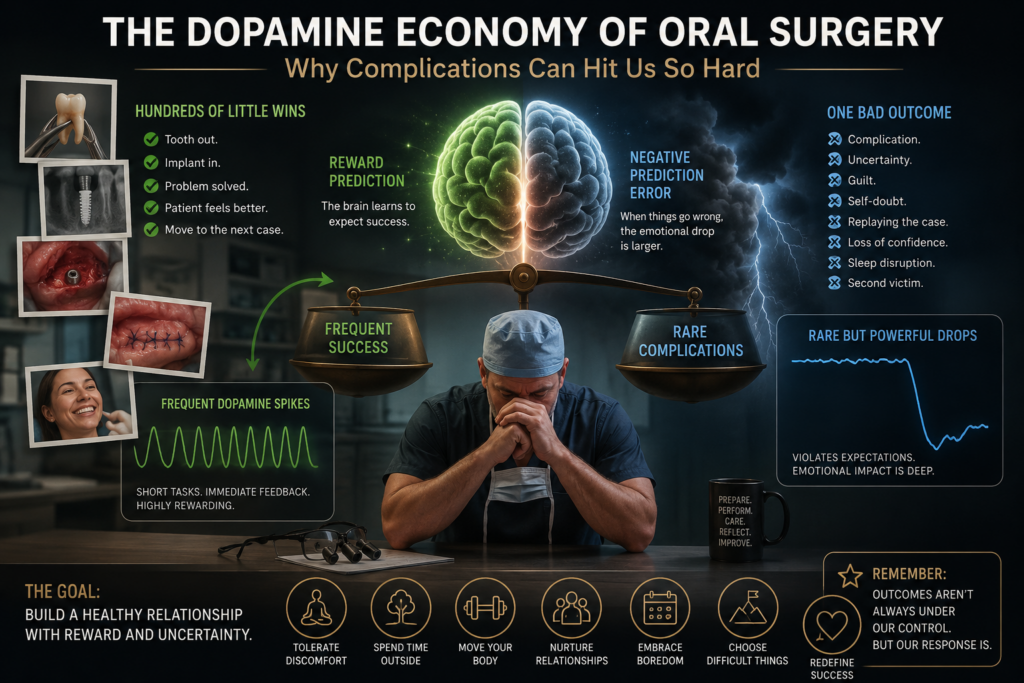
One of the things I love most about oral surgery is that we solve problems—and we often solve them quickly. A patient has an impacted wisdom tooth, and we take it out. A patient is missing a tooth, and we place an implant. There is an abscess, and we drain it. There is bleeding, and we stop it.
Many of our procedures take 5, 10, or 20 minutes, and at the end there is often a satisfying conclusion: the tooth is out, the implant is in, the bleeding has stopped, the problem has been solved. Then we walk into the next room and do it again.
I have started to wonder whether this unique characteristic of oral surgery has an unintended psychological consequence: Does oral surgery condition our brains to expect success? And if it does, could that help explain why the relatively rare occasions when things don’t go well can affect us so profoundly?
Hundreds of Little Wins
Think about the structure of an average oral surgery day. You look at a panoramic radiograph and develop a plan. You recognize the anatomy, anticipate where you need to remove bone, and know where you will section the tooth. Then you begin. You elevate, the tooth moves, you section it, the roots come out, you clean the socket, suture, and move on.
There is something extraordinarily satisfying about completing a task and immediately seeing the result of your work. We may experience that cycle dozens of times every week.
Compare that with other areas of medicine and surgery. A cancer surgeon may perform a technically perfect operation and wait months or years to know the ultimate outcome. Other physicians treat chronic diseases where there may never be a moment when the problem is definitively “finished.”
Oral surgery is different. Our feedback loops are often remarkably short:
Problem → intervention → resolution.
The brain loves completed loops.
When Success Becomes the Baseline
This idea made me think about Anna Lembke’s book Dopamine Nation. One of the concepts she explores is the brain’s constant effort to maintain balance between pleasure and pain. Dopamine is involved not only in pleasure, but also in motivation, anticipation, learning, and reward.
We usually think about dopamine-driven behavior in relation to social media, food, gaming, shopping, drugs, or other highly stimulating activities. But what if our work itself becomes part of a reward cycle?
A busy oral surgery schedule provides an enormous number of reinforcing experiences. A third molar comes out. An implant achieves great primary stability. A frightened patient wakes up smiling. A biopsy comes back benign. The schedule runs on time.
Problem solved. Next patient.
Over years of practice, I wonder if this begins to establish a very high expectation for successful outcomes. Success stops feeling exceptional and starts feeling normal. The implant integrates—of course it did. The extraction heals—of course it did. The infection resolves—of course it did.
Our brains may gradually become calibrated around things going right.
Then Something Doesn’t
An implant fails. A patient develops an infection. A nerve injury doesn’t resolve. A sinus communication doesn’t heal. A pathology report comes back with something unexpected. A patient has an anesthetic complication.
Suddenly, instead of receiving the outcome our brains have experienced hundreds or thousands of times before, we experience the opposite. The psychological fall can feel enormous.
Neuroscience offers an interesting framework for thinking about this: reward prediction error. Our brains are constantly predicting what will happen next, and dopamine plays an important role in that process. In oral surgery, those predictions become incredibly accurate because we repeat similar procedures thousands of times.
When reality suddenly violates the expected outcome, the complication isn’t simply a complication. Something happened that wasn’t supposed to happen.
That may help explain why one complication can occupy our minds more than the 50 successful procedures surrounding it.
Why Complications Feel So Personal
Almost every experienced surgeon knows this feeling. You can have an incredible week in which 50 patients do beautifully, your team performs well, and your surgeries go exactly as planned. But one patient develops a significant complication.
Which patient are you thinking about when you drive home?
Usually that one.
You replay the surgery. Should I have done something differently? Did I miss something? Could I have prevented this? Sometimes you wake up at 3:00 in the morning still thinking about it.
Surgical literature shows that complications can have profound psychological effects on surgeons, including guilt, anxiety, rumination, sleep disturbance, and loss of confidence. I wonder if the structure of oral surgery magnifies some of this because we usually win. Most teeth come out. Most implants integrate. Most infections resolve. Most patients heal.
When failure is statistically uncommon, it can feel like a violation of how our professional world is supposed to work.
The Dangerous Side of the Reward Loop
There may be another consequence. If we become accustomed to rapid, predictable rewards, we may naturally gravitate toward the cases that provide them. We like efficiency, speed, production, and the clean surgical win.
What we may like less are the difficult revision, the patient who isn’t healing, the vague pain complaint without an obvious diagnosis, the failed implant, or the angry patient who needs repeated follow-up.
Those cases don’t give us the satisfying cycle of problem → procedure → solution. Instead, they give us problem → uncertainty → waiting → another problem → more uncertainty.
But those patients need us too. In fact, they may need us more.
Building a Healthier Relationship With Reward
This is where I think some of the ideas in Dopamine Nation become useful for surgeons. We shouldn’t eliminate the rewarding aspects of our work. The satisfaction of technical mastery, relieving suffering, and helping patients is one of the great privileges of our profession.
But we can become more conscious of our relationship with reward. We can learn to tolerate boredom and uncertainty rather than filling every empty moment with stimulation. We can exercise, spend time outside, nurture relationships that have nothing to do with our surgical abilities, and deliberately do difficult things that don’t provide immediate gratification.
Most importantly, we can redefine what constitutes a surgical “win.”
Success isn’t simply implant integration, the absence of complications, operative speed, or production. Success is making a good diagnosis, choosing the proper procedure, preparing well, operating to the best of our ability, recognizing complications early, being honest with patients, and continuing to care for someone when the case stops being easy or rewarding.
Sometimes a perfect surgery has a bad outcome. Sometimes an imperfect surgery has a great outcome.
Biology always gets a vote.
Learning to Live With an Open Loop
Maybe one of the hidden psychological challenges of oral surgery is that we become accustomed to solving problems quickly and definitively. That is part of what makes our specialty so rewarding, but it may also be part of what makes complications so painful.
Eventually every surgeon encounters something that can’t be fixed in 20 minutes with a handpiece and an elevator.
Part of becoming a mature surgeon may be learning to separate our identity from the outcome of our last operation. We should analyze our complications, ask hard questions, learn from our mistakes, and continually improve. But we also have to learn how to exist in uncertainty without immediately needing another win to make ourselves feel better.
Maybe the final stage of surgical maturity isn’t simply learning how to solve increasingly difficult problems. Maybe it is learning how to remain steady when, despite everything we know and everything we do, the problem doesn’t immediately resolve.